
10 Steps to Rebuild Trust in a Relationship After Cheating


We hope you enjoy reading and hopefully learn something! If you would like to schedule a free consultation call with one of our coaches, click here.
Author: Jerry P. | Co Founder of Positive Realist
You can rebuild trust after cheating or lying, but only with clear actions, daily proof, and emotional consistency.
Words won’t rebuild what actions broke. When a person cheats or lies, their partner’s nervous system loses its sense of safety. Every message, delay, or silence now feels like a threat.
Rebuilding trust means rebuilding safety, and safety comes from repetition, not promises.
Ready for Clarity in Your Next Chapter?
Real growth happens when you’re supported. If you’re ready to build clarity, confidence, and steadiness in your life or career, I’m here to help. Let’s take the next step together.
What Exactly to Do to Rebuild Trust? 10 Crucial Steps
Rebuilding trust after betrayal requires specific actions, not just emotional talk. You have to replace uncertainty with proof.
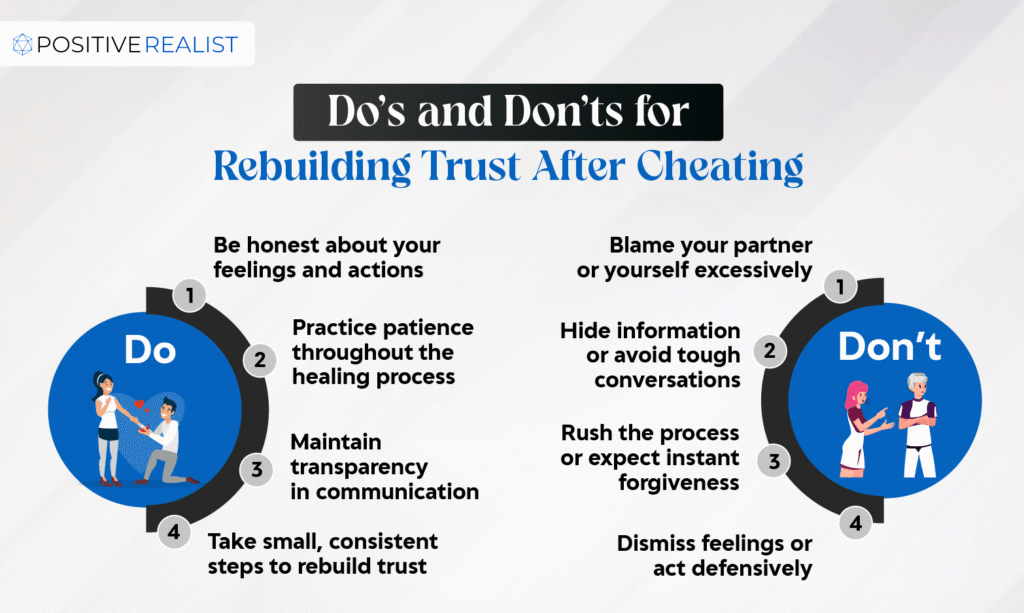
Every step below gives you measurable things to do daily so your partner’s brain and heart can start feeling safe again.
1. Admit Everything at Once: Don’t Leave “Small Details” for Later
If you have cheated or lied, your first step is total disclosure. Hiding even small things will delay healing. Every discovery restarts your partner’s pain cycle.
- Sit down privately. Say, “I am going to tell you everything. I don’t want you to discover more later.”
- Tell the full truth in one conversation. Don’t spread it out over weeks.
- Don’t justify or defend your actions. Just explain what happened.
When there are no new surprises, your partner’s brain can start processing the truth instead of staying alert for “what else.” That’s the beginning of safety.
2. Show Proof of Honesty Daily. Don’t Expect Blind Trust
After betrayal, you don’t get to say, “You have to trust me now.” You have to prove you are trustworthy.
- Keep your phone, social media, and communication open temporarily.
- Share your schedule if your partner asks. Not because they control you, but because predictability rebuilds trust.
- If you say you will text at 8 p.m., do it. If you can’t, tell them why before they ask.
Your partner’s brain is looking for proof that “this person is predictable again.” Small, consistent actions rebuild that pattern.
Psychologist Paul Zak, who studied oxytocin (the “trust hormone”), found that our brain releases oxytocin when we experience honesty, empathy, and consistent care. After betrayal, that chemical connection weakens. So, rebuilding trust means rebuilding emotional safety.
3. Use a “Daily Check-In” Ritual to Reconnect
After lying or cheating, communication breaks down. Silence feels unsafe. Over-talking burns both people out. You need a controlled way to rebuild communication.
- Set a 15-minute daily check-in.
- Each person shares:
- One emotion they felt today.
- One moment, they felt close or distant.
- One small request for tomorrow.
- No blaming, no fighting. It’s a structured emotional update, not a debate.
These short, predictable check-ins rewire communication patterns. Over time, they create emotional reliability, the foundation of trust.
If you struggle with expressing emotions clearly or fear saying the wrong thing, educate yourself on managing expectations in a relationship.
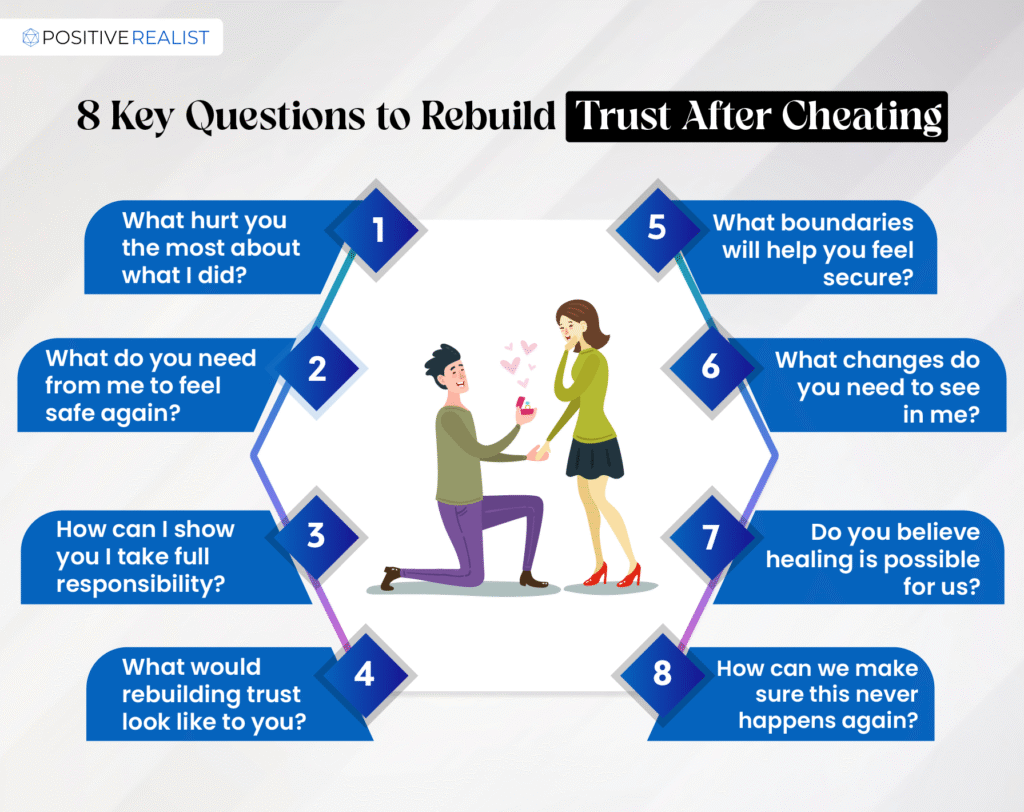
4. Track Promises in Writing and Deliver Them
When trust breaks, memory becomes biased. The hurt partner forgets the good moments, and the one who broke trust forgets the promises made.
- Write down promises in a shared note or journal. For example:
- “I will always tell you when I am running late.”
- “I will answer honestly if you ask about someone.”
- Review the list weekly. Check what’s been done and what hasn’t.
Tracking makes accountability visible. It turns vague “I am trying” into measurable progress.
If one partner lied about money, tracking financial transparency, like weekly shared expenses, shows a visible behavioral change.
5. Repair the Emotional Damage, Not Just the Facts
Telling the truth fixes the information gap. But emotional damage needs its own repair process. Cheating or lying often triggers trauma responses: fear, obsession, flashbacks, or detachment.
- When your partner is triggered, don’t argue about logic. Instead say:
“I know you are scared because of what I did. You have every right to feel that.” - Use physical reassurance if they allow it: holding hands, hugging, or just sitting near them.
- Be patient. Emotional safety takes longer than intellectual forgiveness.
Validation reduces the brain’s threat response. You are proving not only that you are honest, but that you understand their pain.
Many people caught in emotional repair fall into “all-or-nothing” thinking, believing the relationship is either perfect or ruined. That mindset delays healing.
Educate yourself on Binary Thinking and understand how to break that mental pattern and make space for gradual progress.
6. Eliminate “Triggers” That Restart Distrust
Every lie or affair leaves behind reminders: places, people, or behaviors that reignite pain. Remove or manage them clearly.
- If you cheated with someone from work, limit contact or request reassignment.
- If lying involves secret chats, delete those apps or give full access.
- Discuss triggers openly: “What situations make you feel unsafe again?”
Avoiding triggers is not control; it’s part of accountability. You are removing doubt before it appears.
7. Use Third-Party Guidance. Don’t Rely on Emotion Alone
Emotions will not solve this. You need structure.
- Find a licensed therapist trained in Emotionally Focused Therapy (EFT) or the Gottman Method.
- Ask for homework: daily check-ins, emotional regulation, and rebuilding exercises.
- If therapy isn’t accessible, use online tools like structured communication templates or trust-rebuilding workbooks.
You can’t fix what you don’t measure. Therapy provides external regulation, someone neutral guiding progress instead of emotion leading to chaos.
If the idea of therapy makes you anxious or you shut down during emotional conversations, it’s worth understanding Communication Anxiety. You will know how anxiety affects your ability to connect, mostly after betrayal.
8. Stop Saying “Trust Me”. Start Earning It
Trust is not a request; it’s a response.
- Replace “trust me” with “I will show you.”
- Instead of “I said I am sorry,” say, “Here’s what I am doing to change.”
- Continue repeating the pattern until your partner’s nervous system begins to relax.
Trust isn’t rebuilt through conversation; it’s rebuilt through observation. The hurt partner must see, not hear, reliability.
9. Rebuild Identity as a Couple, Not Just Repair the Incident
Cheating or lying changes the relationship permanently; you can’t return to how things were before.
Instead, you have to rebuild it from the ground up with new rules, new honesty, and new habits that actually make it stronger than before.
- Redefine your relationship values together. Example: “From now on, honesty means full disclosure, even if it’s uncomfortable.”
- Create shared new memories that overwrite painful ones.
- Set new boundaries around communication, privacy, and expectations.
10. Give It Time, But Use the Time Productively
Time doesn’t heal by itself. It heals with structure.
- Set a review timeline. Example: “Let’s evaluate how we feel in three months.”
- Don’t expect total forgiveness. Expect gradual comfort.
- Keep tracking emotional stability, not just external behavior.
Healing is a gradual pattern shift. Each consistent day builds safety, which eventually rebuilds trust.

Final Thoughts
Trust doesn’t return as a promise; it returns as proof.
When your actions stay steady long enough, your partner’s body starts to relax. That’s when real healing begins.
If you are serious about repairing your relationship and need expert guidance, book a 1:1 couple counseling session with the team at Positive Realist. You will get structured help from professionals who understand how to rebuild trust step by step, without judgment or vague advice.
People Also Ask
1. Can a relationship survive after cheating or lying?
Yes, if both partners commit to full honesty, consistent effort, and emotional repair. Research shows that up to 70% of couples can rebuild functional trust when they follow a structured process instead of relying on time alone. Healing isn’t automatic; it’s intentional.
2. Should the betrayed partner check phones or messages?
In the early stages, yes, if it helps them feel safe and reduces anxiety. But this should be a temporary phase, not a permanent habit. As your partner consistently proves transparency, the need to check will naturally fade.
3. How do I stop obsessing over what happened?
Don’t try to suppress the thoughts; structure them instead. Use the 15-minute daily check-in to express emotions in small, safe doses rather than replaying them all day. Over time, your brain will learn that it’s safe to rest because the pain is being heard and processed consistently.
4. When is it better to walk away instead of rebuilding?
If your partner refuses accountability, continues to lie, or manipulates your emotions, rebuilding isn’t possible. Trust can only grow in honesty. If they won’t meet you in that space, your energy is better spent healing yourself and creating safety on your own terms.
About the Author
Jerry P.
Jerry P. is a certified Life & Leadership Coach at Positive Realist. He helps professionals and individuals gain clarity, confidence, and actionable strategies for growth
Jerry P. is a certified Life & Leadership Coach at Positive Realist. He helps professionals and individuals gain clarity, confidence, and actionable strategies for growth



![Family Therapy Activities [Strengthen Bonds with 5 Ideas]](https://www.positiverealist.com/wp-content/uploads/2024/02/Family-Therapy-Activities.jpg)
