
5 Tips to Heal Trauma Blocking: Don’t Shut Down the Pain!


We hope you enjoy reading and hopefully learn something! If you would like to schedule a free consultation call with one of our coaches, click here.
Author: Jerry P. | Co Founder of Positive Realist
Trauma blocking happens when your mind or body shuts down painful memories or emotions to protect you. When people go through trauma, like abuse, loss, violence, or an accident, the brain tries to help them survive. Sometimes, it does that by blocking or numbing the pain. You might forget parts of what happened.
Or you may feel empty, disconnected, or “numb” instead of sad or angry.
But when trauma blocking stays for too long, it stops healing. The same shield that once protected you can later trap you inside.
Ready for Clarity in Your Next Chapter?
Real growth happens when you’re supported. If you’re ready to build clarity, confidence, and steadiness in your life or career, I’m here to help. Let’s take the next step together.
What Is Trauma Blocking?
Trauma blocking can show up in many ways: avoiding memories, staying constantly busy, overworking, sleeping too much, or using substances like alcohol or drugs to numb feelings.
Research in neuropsychology shows that trauma affects how our amygdala, hippocampus, and prefrontal cortex work together.
- The amygdala reacts to fear and danger.
- The hippocampus organizes memories.
- The prefrontal cortex helps us think and reason.
The amygdala becomes hyperactive when trauma occurs, while the hippocampus and prefrontal cortex reduce their functioning.
That’s why traumatic events often feel chaotic, fragmented, or out of order in memory. In that moment, the brain’s main goal is not understanding, but surviving.
Sometimes, this black-and-white way of coping comes from binary thinking, seeing emotions as “good” or “bad,” instead of understanding that both can exist together.
How Does the Body Block Trauma?
The body plays a huge role, too. During a traumatic event, the body floods with stress hormones such as adrenaline and cortisol, preparing you to react quickly and get to safety.
But when stress becomes too much or too frequent, the body can shut down instead of fighting or fleeing.
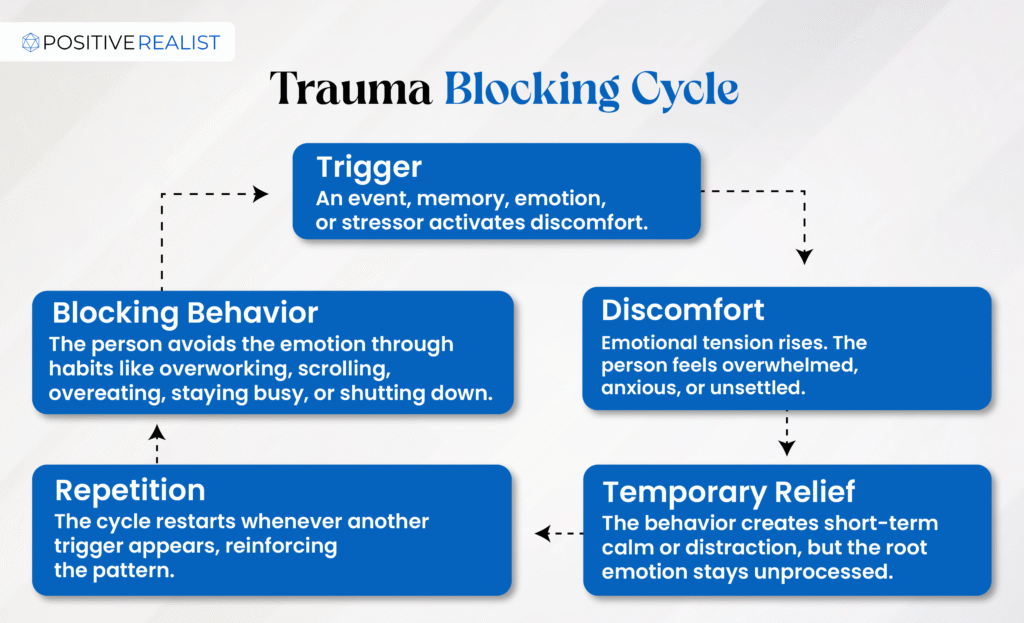
As per Harvard Health, this is called the freeze response, a biological trauma block. Your body goes numb, your muscles tighten, and your heartbeat slows.
Over time, if trauma isn’t processed, the body “remembers” it. You may develop chronic pain, digestive problems, fatigue, or panic without knowing why.
4 Types of Psychological Trauma Blocking
Emotional trauma blocking is when you disconnect from feelings to stay safe. For example:
- Avoidance: You stay away from reminders of what happened.
- Emotional Numbing: You stop feeling joy, love, or sadness.
- Distraction: You always keep yourself busy, so feelings can’t surface.
- Substance Use: You drink, eat, or scroll social media to escape.
These are coping tools that once worked. But they come with a cost.
Why People Don’t Realize They are Blocking Trauma
Many people don’t know they are blocking trauma. They think they have “moved on.” But the signs often show up quietly:
- You feel detached or “not fully present.”
- You have memory gaps about painful times.
- You overreact to small triggers without knowing why.
- You avoid certain topics or people for no clear reason.
- You often feel tired, anxious, or emotionally flat.
This blocking is not your fault. The brain attempts to keep you safe. The problem is, what protected you once may now prevent you from fully living.
This often connects to how we manage expectations, of ourselves, of others, and of healing itself. Expecting to “just get over it” adds pressure instead of peace.
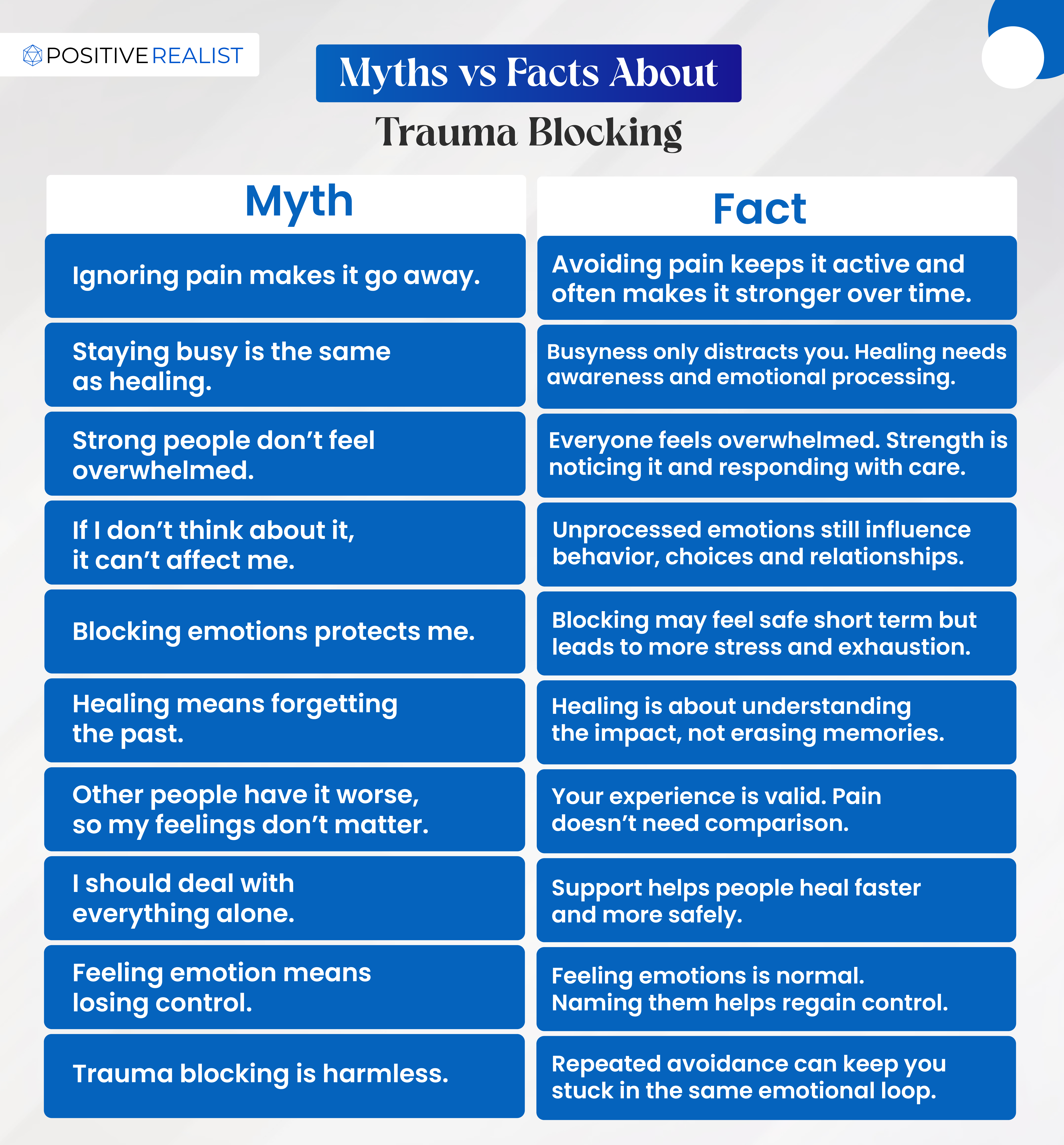
Breaking the Trauma Block: 5 Helpful Tips
Healing trauma blocking doesn’t mean forcing yourself to remember everything or relive pain. It means slowly reconnecting with your body and emotions in safe ways.
1. Body Awareness and Movement
When a person experiences trauma, the body often remembers what the mind tries to bury. It holds on to the tension, the fear, and the unspoken memories that language can’t fully express.
You might notice it as tension in your shoulders, shallow breathing, or feeling disconnected from your body.
Gentle movement can help release that. Yoga, stretching, walking, or even slow breathing are not about fitness, they are about feeling again.
2. Therapy
A trauma-informed therapist can guide you through your healing journey with care and help you process experiences safely and at a pace that feels right for you.
There’s no need to force memories or re-experience old pain. Therapy offers a space to gently make sense of what once felt overwhelming.
Methods such as EMDR (Eye Movement Desensitization and Reprocessing), Somatic Experiencing, and CBT (Cognitive Behavioral Therapy) have proven effective in easing trauma-related symptoms.
Most importantly, true healing begins with trust—when you feel secure, acknowledged, and deeply understood.
3. Mindfulness and Grounding
Trauma can make the present moment feel unsafe.
Your mind may drift to past pain or future fears, but mindfulness softly guides you back to the present.
Don’t empty your thoughts. Instead, observe them with kindness and awareness. Grounding techniques can help too: notice your feet on the floor, take slow, steady breaths, or hold a textured object to anchor yourself in the here and now.
4. Building Safety
You can’t heal when you still feel in danger.
This could be like creating calming routines, setting boundaries, or finding people who respect your space.
Safety isn’t only about protection from harm. It’s about peace, knowing you can rest, speak, and exist without fear.
When your body feels safe, healing finally has room to grow.
5. Self-Compassion
Many survivors carry guilt or shame for how they coped.
But blocking pain was never a weakness. It was survival.
You did what you needed to do to stay alive.
That deserves understanding, not judgment.
Can Trauma Blocking Ever Be Good?
In the short term, yes. Trauma blocking helps you survive unbearable situations. Soldiers, abuse survivors, or accident victims often rely on it unconsciously. But in the long run, it becomes unhealthy when it keeps you disconnected from life, emotions, or relationships.
Final Thoughts
Your mind and body did what they needed to keep you safe. But now, you deserve more than just surviving. You deserve to feel alive again.
Positive Realist’s Mindset Coaching helps you do exactly that. You will learn how to:
- Get your triggers and emotional barriers.
- Soothe your nervous system and restore a sense of safety within your body.
- Reconnect with your emotions without feeling overwhelmed.
- Create a mindset that supports peace, not protection.
You have already made it through the toughest part.
Now it’s your time to heal, with care and support that truly understands what trauma feels like.
Start your 1:1 online sessions with Positive Realist today.
People Also Ask
Is trauma blocking the same as repression?
Not quite. Repression usually means the mind has completely buried a memory, keeping it out of awareness. Trauma blocking is broader. It can show up as emotional numbness, avoidance, or denial. You might still remember what happened, but feel disconnected from it.
How can I tell if I’m blocking trauma?
There are small signs that your mind might be protecting you. You may notice emotional numbness, gaps in your memory, or strong reactions to things that don’t seem serious.
Can trauma blocking be reversed?
Yes, it can. Your mind and body can learn to feel safe again with the right support. Therapy, mindfulness, and body-based healing approaches like yoga or EMDR can gently help you reconnect with emotions that were once too painful. Healing takes time, but it happens slowly and safely, not all at once.
Is trauma blocking permanent?
No, the brain and body are incredibly adaptable. When you begin to feel secure in yourself and your surroundings, the memories and emotions that were once blocked can begin to surface and integrate naturally.
About the Author
Jerry P.
Jerry P. is a certified Life & Leadership Coach at Positive Realist. He helps professionals and individuals gain clarity, confidence, and actionable strategies for growth
Jerry P. is a certified Life & Leadership Coach at Positive Realist. He helps professionals and individuals gain clarity, confidence, and actionable strategies for growth


